Why Zillow Estimates Aren’t Local (and What Actually Moves Value on the Gulf Coast)
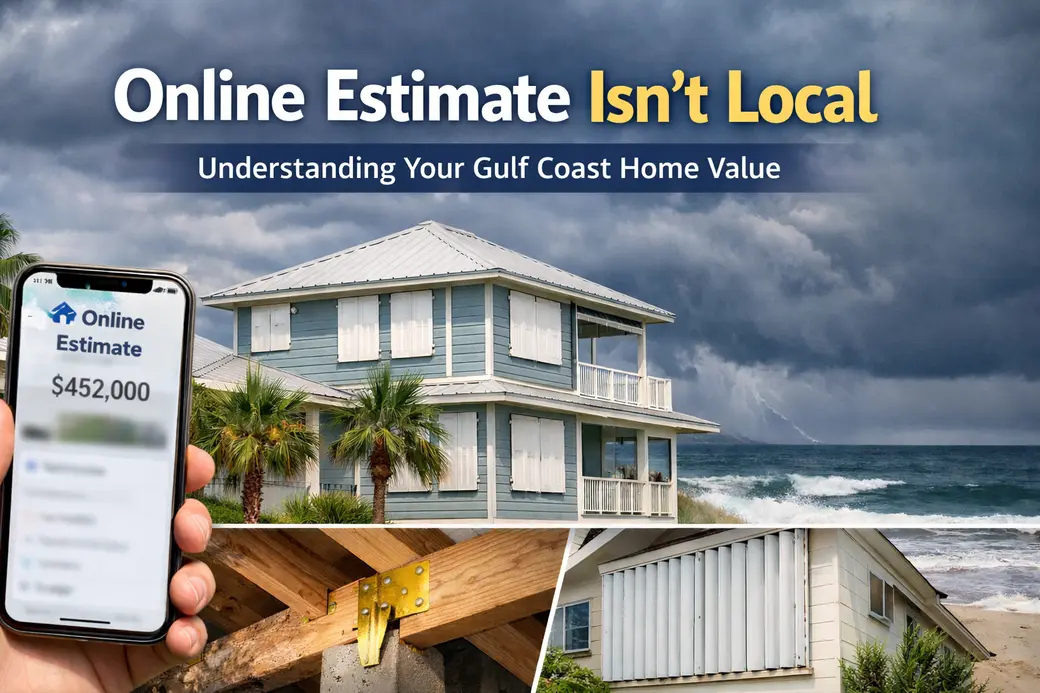
Online Home Value Estimates Aren’t Local (Here’s What Actually Moves Value on the Gulf Coast)
If you’ve ever looked up your home online and thought, “Wait… that is what it says my house is worth?” — you’re not alone.
Online estimates can be a helpful starting point, but on the Gulf Coast, they often miss the exact details that swing value in real life. Not because the internet is evil. Because our market is hyper-local, and coastal reality doesn’t fit neatly into an algorithm.
Let’s break down what those estimates can’t reliably “see,” and how to sanity-check your number without spiraling.
First: what an online estimate is (and what it isn’t)
Most automated home values are built from data the platform can access: recent sales, public records, broad market trends, and basic property facts.
That can be useful for a rough range.
But it’s not walking through your home. It’s not noticing condition. And it’s definitely not weighing coastal factors the same way actual buyers (and insurers) do.
Why the Gulf Coast throws off the math
On the Alabama and Florida Gulf Coast, value can change based on details that aren’t consistently captured in the data—or don’t show up in a clean, comparable way.
Here are the big ones:
1) Insurance-impacting updates
A new roof isn’t just “nice.” Around here, it can influence insurance options and cost—and that affects what buyers feel comfortable paying.
Storm-mitigation features matter too, like:
-
hurricane shutters / storm panels
-
impact-rated openings (windows/doors)
-
reinforced connections and other mitigation upgrades
Online estimates don’t consistently credit these the way a human comp analysis can.
2) Rules and restrictions buyers care about
Short-term rental rules, HOA restrictions, condo rules, and zoning quirks can change demand fast.
If a buyer is thinking, “Can I rent this later?” or “What can I do with this property?” those answers affect pricing—and the online number may not reflect it.
3) “Comps” that aren’t truly comparable
A real value range isn’t just “same zip code, similar square footage.”
Comparable means:
-
similar condition
-
similar updates
-
similar layout/function
-
similar neighborhood feel
-
similar buyer demand
And some relevant sales don’t show up neatly (or they’re oddball situations that don’t define the market).
4) Location nuance (it’s not just distance to the beach)
Location is traffic patterns, flood considerations, street vibe, neighborhood demand, and what buyers are prioritizing right now. Coastal markets have micro-markets—sometimes block-by-block.
A quick reality check you can do in 5 minutes
If your online estimate feels off, try this:
1) Look at sold homes, not active listings
Active listings are what people hope for. Sold listings are what people paid.
2) Compare condition honestly
If your home has major updates and the comps don’t, that matters. If yours needs work and the comps were renovated, that matters too.
3) Ask: what would a buyer notice in the first 60 seconds?
Roof age, storm protection, curb appeal, obvious deferred maintenance—those factors move the needle.
4) Get a local comp-based range
This is the cleanest way to stop guessing. Local comps + context beat algorithms every time.
The takeaway
Online estimates aren’t “lying.” They’re guessing with incomplete context—and on the Gulf Coast, context is basically the whole thing.
If you want a quick comp-based value range (with a plain-English explanation of what I’m using and why), comment or message me VALUE and I’ll send it over. No pressure—just clarity.
Want the audio version? Listen to the Keys & Clarity episode here:
https://open.spotify.com/episode/1gsL3jWTwlfBAIRgw7VfhZ?si=rxhcfuakSNy80BTUFChawg
Katie Ragland / 256-366-6974 / Real Broker, LLC
Categories
Recent Posts