Foley’s Growth Plan + City Council Agenda: What It Means for You (Without the Government-Speak)
What do Foley’s latest planning and city council decisions actually mean for you if you live here, want to move here, or own property here?
Foley is putting clearer “guardrails” around growth with an updated Comprehensive Plan, while also tackling nuts-and-bolts items like fees, infrastructure rules, and industrial park deals. Translation: these decisions can shape where development goes, how traffic flows, and what costs show up behind the scenes in future building and expansion.
Foley’s updated Comprehensive Plan is the “growth blueprint”
If you’ve ever said, “Why is THAT going there?” — this is the document Foley uses to answer that question before projects hit the table.
Here’s what the City of Foley says this updated Comprehensive Plan is meant to do:
-
Guide development in a more predictable way (clearer expectations for where and how growth should happen).
-
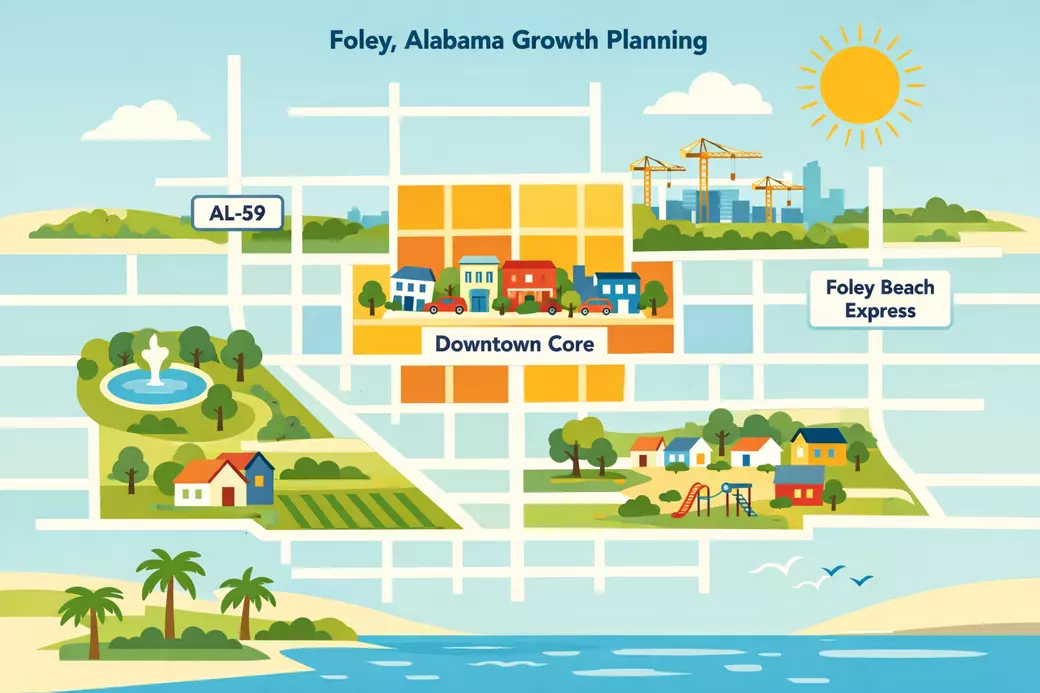
Concentrate higher-density development closer to the city center, then step down in intensity as you move outward.
-
Encourage mixed-use areas (think: living + shopping/food/services in the same area) and better connectivity so everything isn’t funneling into one traffic choke point.
-
Use design ideas pulled from Foley’s original layout — like more compact street grids and more “nodes” that function like mini-centers along corridors like AL-59 and the Foley Beach Express.
My real-life translation: This isn’t zoning, but it often influences zoning. It’s the “why” behind future updates to things like zoning rules, subdivision regulations, and technical design standards.
Why you should care (even if you don’t plan to build a thing)
Because planning decisions tend to show up in your life as:
-
Traffic patterns and road improvements
-
Where new retail and services pop up
-
What areas get denser housing vs. larger-lot development
-
How “walkable” or connected areas become over time
-
How public projects line up with private development
If you’re buying: this can impact what the area feels like five years from now, not just what it feels like today.
If you’re selling: this can influence buyer interest when people start asking, “What’s planned nearby?”
Meanwhile, Foley City Council is also working through the practical stuff
The other article is basically a peek at what’s on the city’s “to-do list,” including budget cleanup and ordinances that affect building and infrastructure.
Here are a few agenda items worth understanding in normal-human terms:
1) Budget/accounting cleanup for items that never arrived
Foley is looking to amend capital purchase accounts for fiscal year 2025 after some approved purchases didn’t arrive (the article notes items valued up to $117,859 across departments).
Why it matters to you: This isn’t spicy, but it’s part of how cities keep projects and departments funded accurately.
2) Proposed permit and impact fee changes (aka: “costs that can roll into development”)
The council agenda includes an ordinance item that would:
-
Raise the plan review fee for single-family or two-family new construction from $50 to $150 (first reading).
-
Adjust impact fees, listed as $2,974 (single-family) and $1,718 (multi-family) in the agenda item.
Why it matters to you: Fees like these typically don’t get paid by “vibes.” They’re part of the overall cost of building — and costs tend to show up somewhere in pricing over time.
3) A proposed ordinance for work in public rights-of-way
There’s also a first reading of an ordinance requiring a permit to work within public rights-of-way.
Why it matters: This can impact how utilities, contractors, and infrastructure work gets managed — which can affect timelines and coordination.
4) Industrial park land deals + economic development moves
On the agenda:
-
A proposed ordinance to sell city property in the West Foley Industrial Park (USS Innovations: 18.5 acres at $50,000/acre).
-
Discussion of a contract with Glacier for 4.5 acres at $50,000/acre, with the article noting plans for a facility investment and jobs.
Why it matters: Industrial growth can mean jobs and investment — and also more traffic and infrastructure pressure, depending on where it lands.
5) Impact fee study discussion
The agenda also mentions authorizing an impact fee study (TischlerBise, $65,960).
Why it matters: Studies like this are often step one before adjusting fee structures.
What to do with this info (without making it your full-time job)
Here’s the low-effort, high-impact version:
-
If you’re buying: ask, “What’s planned near this area?”
-
Not as a panic question — as a clarity question.
-
-
If you already own: keep an eye on corridors you use every week (AL-59, Beach Express areas, etc.). Long-term plans tend to show up there first.
-
If you’re curious: skim city agendas when you can. You don’t need to understand every line item — just look for repeat themes like “fees,” “roads,” “subdivision,” “rights-of-way,” and “zoning.”
Final takeaway
Foley isn’t just “growing.” It’s trying to grow with a plan — and the day-to-day council agenda is where those big-picture goals turn into real rules, budgets, and projects. If you want to live here (or invest here) without getting blindsided later, this is the kind of stuff worth tracking.
If you’re looking at a specific neighborhood, corridor, or property in or around Foley and you want help thinking through “what might change here,” tell me the general area and I’ll help you build a smart list of questions to ask.
Want the audio version? Listen to the Keys & Clarity episode here:
https://open.spotify.com/episode/4f0vIb6NAFQkpd0GEzw7Mz?si=b4fl5pKoTxeb3W8vhDuIzQ
—
Katie Ragland / 256-366-6974 / Real Broker, LLC
https://linktr.ee/katieraglandrealtor
Categories
Recent Posts